
ASSESSMENTS
Neurodevelopmental &
Psycho-Educational
Stephanie has a special interest in neuro-affirming psychological assessment and in particular, the identification of Autism in females and gender diverse youth. Stephanie provides assessment for children and young adults from age six to twenty-five years. Stephanie also takes on a small number of adult assessments.
Stephanie is formally trained in the administration of both the Monteiro Interview Guidelines for Diagnosing the Autism Spectrum, Second Edition (MIGDAS-2) and the Autism Diagnostic Observation Schedule, Second Edition (ADOS-2), applying a neuro-affirming interpretive lens to these highly well-regarded evaluation tools.
Assessments provide individuals with an opportunity to learn more about themselves and create plans for navigating the road ahead.

-
Autism
Identification of Autism.
This services is provided from ages six to twenty five years. Limited adult assessment provided (25y +). -
ADHD
Identification of attentional differences.
This service is provided from six (Grade One +) to twenty five years. Limited adult assessments available (25y +). -
Educational
Educational assessments establish a profile of strengths and needs in relation to core academic components such as reading; writing; and mathematics.
Used to identify specific learning differences such as Dyslexia; Dyscalculia; and Dygraphia. -
Cognitive (IQ)
A cognitive assessment generates an IQ score and a profile of intellectual strengths and needs. Families often seek these to support educational planning or funding applications. Typically referred to as ‘IQ’ assessments, a cognitive profile is included in other assessments as it provides further guidance for personalising recommendations and uncovering strengths.
-
Functional / Adaptive Assessments
Typically carried out alongside other assessments to understand a persons independent daily living skills and to inform support needs.
-
Combined Assessments
Families often seek combined assessments. For example, families may seek to understand if their child meets criteria for both Autism and a learning difference. In these instances, comprehensive assessments are provided. Please be in touch to ensure we can provide you with an accurate assessment pathway.
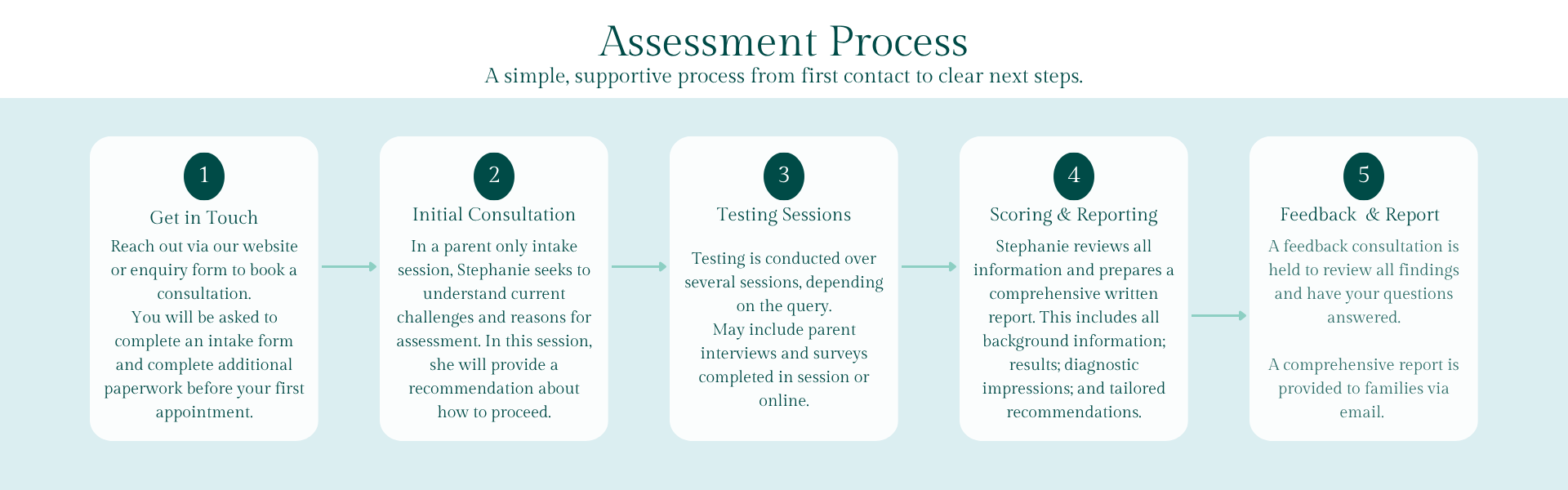
Assessment journeys must be tailored to the individual and in keeping with their questions, their context and what they hope to gain from the process. The assessment snapshots above can be useful to guide families, however, it is always recommended that a collaborative one on one intake session helps to clarify and establish assessment goals.
-
Thorough collection of developmental history and understanding of assessment purpose
Due consideration for the tools utilised, such as neuro-affirming and Gold Standard
Standardised administration in line with professional training
Liaison with key support people and stakeholders
Meaningful interpretation of assessment data
Feasible, affirming, and evidence-based recommendations
Comprehensive written report with recommendations
Timeliness and honest, transparent communication